Webinar: Turning patient stories into global policy
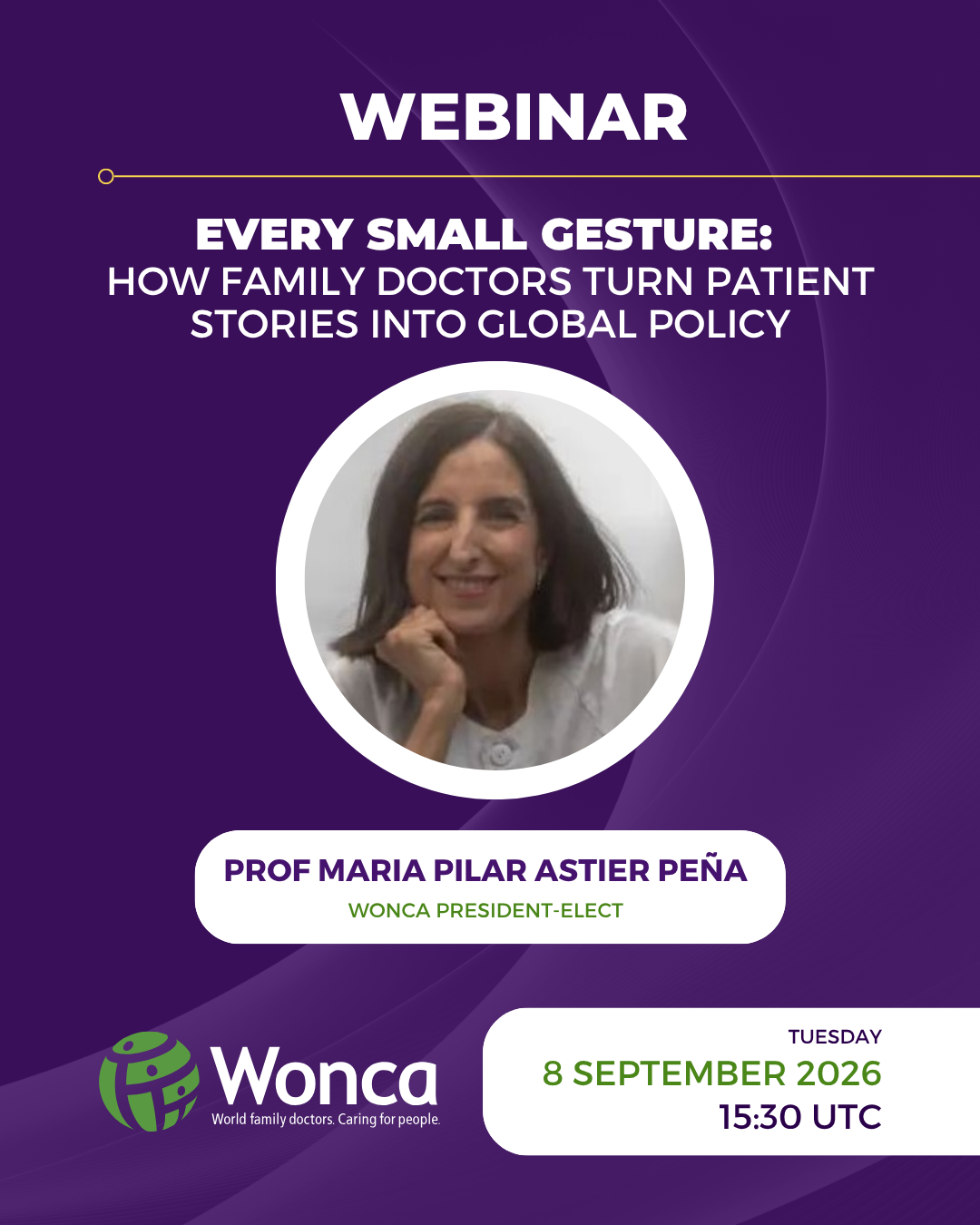
The WONCA Special Interest Group on Policy Advocacy invites family doctors and colleagues to a webinar with WONCA President-Elect Prof Maria Pilar Astier Peña.
Family medicine has a distinctive voice in health policy, and it begins with listening to patients. Drawing on her experience across clinical practice, research, and international advocacy, Prof Astier Peña will explore how the everyday work of family doctors, the small gestures and the patient stories at the heart of primary care, can shape policy at national and global levels.
Date: Tuesday, 8 September 2026
Time: 15:30 UTC
Speaker: Prof Maria Pilar Astier Peña, WONCA President-Elect
Moderator: Dr Sankha Randenikumara, Co-chair, SIG on Policy Advocacy
About the speaker
Prof Maria Pilar Astier Peña is WONCA President-Elect for the 2025 to 2027 term and will serve as President for the 2027 to 2029 biennium, the first Spanish family doctor to hold the role. She works as a family doctor in Zaragoza, Spain, and is a professor at the University of Zaragoza, where she teaches clinical reasoning, professionalism, and clinical ethics. She is a recognised international expert in patient safety and healthcare quality, has advised bodies including the WHO and the OECD, and served as WONCA WHO Liaison Officer.
Watch the Recording
Watch the webinar: Every Small Gesture: How Family Doctors Turn Patient Histories into Global Policy
How does an experience in a family doctor's consultation room become a change in health policy? In a webinar hosted by the WONCA Special Interest Group on Policy Advocacy, WONCA President-Elect Prof Maria Pilar Astier Peña explored how family doctors can connect individual patient experiences with advocacy at local, national, regional and global levels.
Prof Astier Peña drew on her background in both public health and family medicine. Public health, she explained, provides a way to identify patterns and inequalities across populations, while family medicine brings doctors into direct contact with the reality of an individual patient's life.
“You do not need a mandate to start. You need a patient encounter that'll show you the gap.”
Four case studies illustrated how this can work in practice. At local level, Prof Astier Peña described how concerns raised by a patient about rapid population growth in her Zaragoza neighbourhood contributed to a campaign for a new primary care centre. Family doctors and community representatives combined local advocacy with demographic and health evidence, taking their case to the regional ombudsman. The new centre eventually opened in March 2023.
At national level, she examined patient safety in Spain and the challenge facing health professionals who want to apologise and learn after an adverse event but fear legal consequences. The experience led to work with scientific societies, legal experts, health authorities and the Ministry of Health on recommendations supporting learning and a no-blame patient safety culture.
Prof Astier Peña then turned to the ongoing campaign for recognition of family medicine as a specialty at European Union level. She stressed the importance of coalition building, including work involving WONCA Europe, UEMO, WHO Europe and other primary care organisations.
Her fourth example focused on noncommunicable diseases. Patients increasingly live with several chronic conditions at once, she said, while health systems and clinical guidelines can remain organised around individual diseases. This creates a strong case for family medicine's coordinating role and for continued advocacy for primary healthcare at global level.
“Trust builds slowly, but is spent quickly.”
Across the four examples, Prof Astier Peña identified two foundations for effective advocacy: a strategic approach grounded in evidence and a relational approach based on trust, shared ownership and broad coalitions. She encouraged family doctors to look at recurring frustrations in their own consultations and ask whether they reveal a wider structural problem.
Her closing message was simple: effective advocacy requires “patience, persistence and perspective”, and major policy campaigns can begin with a small gesture between a doctor and a patient.
Watch the full webinar on the WONCA YouTube channel.