WONCA publishes guidance on the ethical use of AI in primary care
The World Organization of Family Doctors (WONCA) has published guidance on the ethical use of artificial intelligence (AI) in primary care. Developed by the WONCA Working Party on Ethics and Professionalism, with the support of the WONCA Working Party on Digital Health, it gives family doctors 11 recommendations and 30 questions to help them review an AI tool before using it in practice.
AI applications are being developed and deployed in healthcare at an unprecedented pace, driven largely by advances in large language models and generative AI. The guidance recognises the opportunities this brings for primary care, including support for patient empowerment, self-care and administrative efficiency. It also warns that AI tools can cause harm if they are introduced without appropriate evidence, safeguards or ethical oversight.
The guidance defines AI, machine learning and large language models in the healthcare context, outlines the opportunities and ethical challenges for primary care and sets out the values and principles that should guide the use of AI. It then offers practical guidance for family doctors who are thinking of using AI tools in their daily practice.
2 fundamental requirements
The first 2 recommendations set out what should ideally be in place before a family doctor uses an AI tool:
- Validation and regulation: family doctors should only use AI tools that have been validated and that meet regulatory standards specific to clinical use in primary care.
- Collaboration: the implementation of AI in primary care is too complex to be delegated to individual practitioners. The guidance advises family doctors to share experiences, seek guidance and collaborate at local, regional and international levels.
Following the precautionary principle, the guidance says the default position should be not to use generative AI applications in primary care unless they have undergone sufficient scrutiny and meet ethical and clinical requirements.
9 practical considerations
The authors acknowledge that most AI tools have not been thoroughly validated and that robust AI regulation is lacking in most countries. Ideally, reviewing a tool should not fall on the shoulders of the individual family doctor, but family doctors need a process in place if they wish to start using one. For promising tools that have some evidence behind them but have not been fully validated or are unregulated, the guidance sets out 9 considerations:
- Evidence
- Risk of harm
- Data review
- Co-design
- Patient information and consent
- Inclusion and equity
- Sustainability and planetary health
- Integration and impact on workflow
- Ongoing monitoring
Each consideration comes with questions to guide the review, 30 in all. They ask, for example, whether the tool has been tested specifically in primary care settings, how harm will be managed if it occurs and what impact the tool has on carbon emissions and water use.
The 30 questions are also available as a printable 2-page checklist. Family doctors may not be able to answer every question, or it may not be clear whether a tool meets a minimum standard for use in primary care. In such cases, the guidance recommends caution.
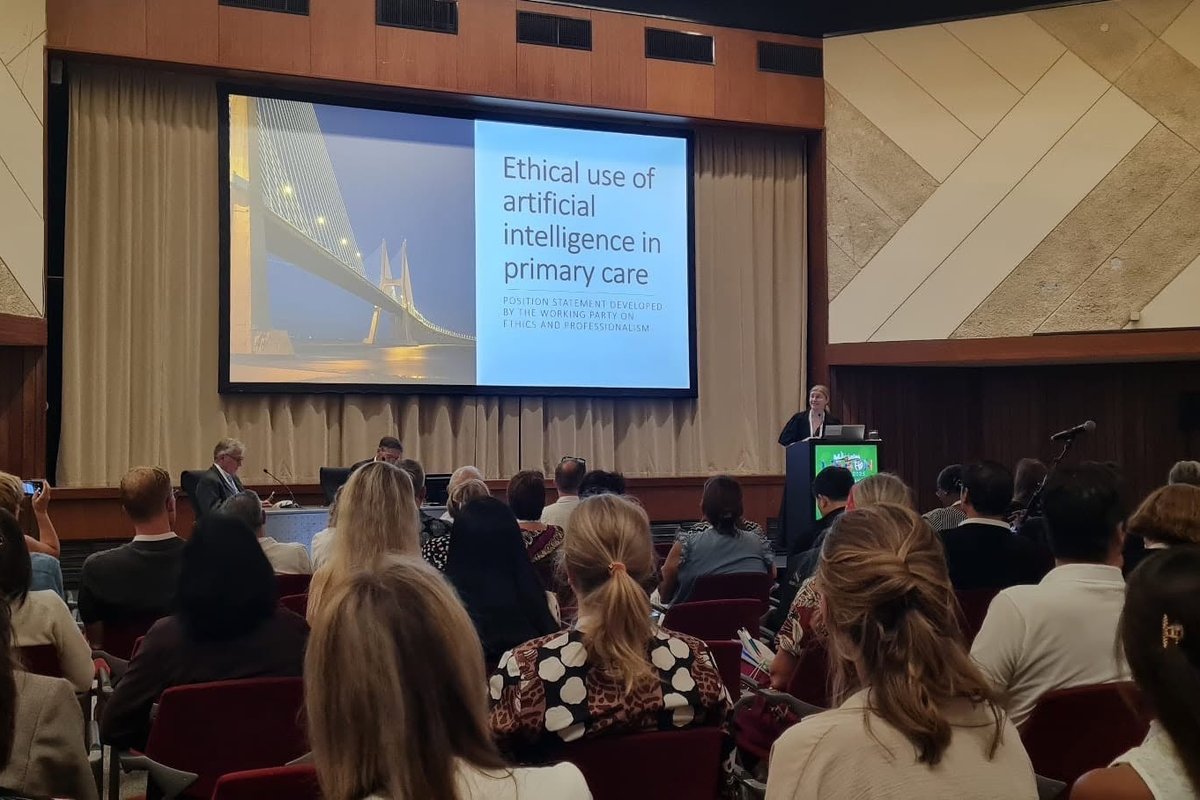 Tania Moerenhout presents the Working Party's draft guidance on the ethical use of AI in primary care at the 25th WONCA World Conference, Lisbon, September 2025
Next steps
The guidance proposes roundtable dialogues that bring together clinicians, patients, regulators, technology vendors, ethicists and other experts to help formulate future roadmaps for the ethical development and implementation of AI in healthcare. It suggests 3 initial priorities: equity, accessibility and inclusive design; data governance and consent models; and regulatory harmonisation for AI software as a medical device and clinical decision support systems.
The authors acknowledge that any guidance on AI risks being outdated as soon as it is published. They argue, however, that the underlying values and principles remain stable over time, and that building them into the design and implementation of technology is vital if AI tools are to support family doctors in their work rather than undermine them.
The Working Party is keen to engage with individual practitioners, other WONCA Working Parties and Special Interest Groups, as well as national and international organisations, to take this work forward.
The authors
The guidance was written by the following authors, with the WONCA Working Party on Ethics and Professionalism:
- Tania Moerenhout, lead author and former Chair of the WONCA Working Party on Ethics and Professionalism
Department of Bioethics, University of Otago, Dunedin, Aotearoa New Zealand
- Avni Patel
Tanglin Health Clinic, Ministry of Health Malaysia, Kuala Lumpur, Malaysia
- Andrew Papanikitas, Chair of the WONCA Working Party on Ethics and Professionalism
Nuffield Department of Primary Care Health Sciences, University of Oxford, United Kingdom
- Issam Shaarani
Faculty of Medicine, Beirut Arab University, Beirut, Lebanon
- Keith Thompson
Department of Family Medicine, Schulich School of Medicine & Dentistry, Western University, London, Ontario, Canada
Find out more about the WONCA Working Party on Ethics and Professionalism and the WONCA Working Party on Digital Health.
How to cite the guidance
Moerenhout T, Patel A, Papanikitas A, Shaarani I, Thompson K, WONCA Working Party on Ethics and Professionalism. Guidance document on the ethical use of artificial intelligence in primary care. World Organization of Family Doctors (WONCA); 2026. Available from: https://www.globalfamilydoctor.com/Resources/ethical-ai-primary-care.aspx