Author Interview: Muna Chowdhury

This interview with Muna Chowdhury, one of the editors of the new WONCA book Working with Adolescents and Young Adults in General Practice: A Guide for Family Physicians, explores why young people need to be understood as a distinct group in primary care, what family doctors most often miss, and how the book supports clinicians in everyday practice. Edited with Pierre-Paul Tellier and Maria Veronica Svetaz, the book grows out of the WONCA Special Interest Group on Adolescent and Young Adult Care, which the three editors have led between them.
The three of you have led the WONCA Special Interest Group on Adolescent and Young Adult Care between you, and the book grows out of that community. How did the SIG shape what this book set out to do, and what does it offer a family doctor who has never thought of adolescents as a distinct group?
The WONCA Special Interest Group was really the catalyst for the book. Through the SIG, we brought together clinicians, educators and researchers from many different countries who were all grappling with the same question: how can primary care better meet the needs of young people? What emerged was a recognition that adolescence and young adulthood are not simply extensions of childhood or adulthood. They are a distinct developmental stage, with unique health care needs.
The book offers a practical framework for family physicians. It shows that small changes in communication, consultation style and understanding of the adolescent developmental stage can have a profound effect on engagement, trust and ultimately health outcomes. The aim is to help family doctors have greater confidence to care for young people as part of their everyday practice.
The health challenges facing young people today seem to be shifting fast, from mental health and disordered eating to substance use and the pressures of identity formation. What worries you most about what you are seeing in practice?
What concerns me most is the growing complexity in young people’s lives. Mental health difficulties, social pressures, family instability, online influences and economic uncertainty rarely occur in isolation. Many young people present with symptoms that appear straightforward, but beneath them are multiple interacting challenges as all these factors intersect.
At the same time, many health systems remain organised around single diagnoses and short consultations. The gap between the complexity of young people’s needs and the capacity of our existing services to respond is widening. Yet I remain optimistic, because family medicine is uniquely placed to provide a safe environment, a trusted relationship and continuity of care, which is often exactly what young people need to feel supported.
What are some of the most effective strategies for supporting young adults as they navigate this important stage of life?
The most effective strategy is to see young adults not simply as patients with problems to solve, but as individuals undergoing a period of remarkable growth, change and opportunity. Family doctors are uniquely positioned to support that journey, because we often care for young people over time and within the context of their families and communities.
Building trust is fundamental. Taking time to listen, respecting confidentiality, and engaging young adults as active partners in decision-making can make an enormous difference. Many young people are navigating major transitions in education, work, relationships and identity, and they benefit from clinicians who are curious about their lives, not just their symptoms.
It is also important to focus on strengths as well as risks. While we need to identify mental health concerns, substance use or other challenges, we should also ask about supportive relationships, achievements, interests and aspirations. These strengths are often powerful protective factors that can be built upon.
Finally, continuity of care matters. Young adulthood can be a time when people disengage from health services. A family doctor who provides a consistent, non-judgmental and welcoming relationship can help young people feel connected to care and better equipped to manage their health throughout adulthood.
You brought together contributors from very different regions and health systems. What surprised you most during the process, and did anything you assumed was universal turn out not to be?
One of the most striking findings was how much common ground existed despite enormous differences in resources, culture and healthcare systems. Whether contributors were working in high-income countries or resource-constrained settings, they described many of the same challenges: building trust, maintaining confidentiality, supporting mental health, and helping young people navigate transitions.
What was less universal than I expected was the structure of care itself. Access to primary care, legal frameworks around consent, and the role of families varied considerably. Those differences reminded us that while developmental principles may be universal, healthcare solutions must always be adapted to local realities and to unique family, community and sociocultural contexts.
Confidentiality with young patients can put doctors in a difficult position with parents who want to know what is going on. How do you handle that tension?
I try to frame confidentiality as something that benefits everyone, including parents. Young people are far more likely to seek help and speak honestly if they know they can do so in confidence. I explain this early and routinely, so it becomes a normal part of adolescent care rather than something that appears secretive.
At the same time, confidentiality is not absolute. If there are serious concerns about safety or risk of harm, those need to be addressed. The key is transparency. I explain clearly to young people what will remain confidential and under what circumstances information may need to be shared. Most parents understand when they see that the goal is to support the young person’s health and wellbeing.
The book devotes real attention to highly vulnerable young people, including child soldiers and asylum-seeking or trafficked youth. What do family doctors most often miss when these patients are in front of them?
What family doctors most often miss is not a diagnosis but the context in which that young person is living. These young people frequently present with common primary care complaints, such as headaches, abdominal pain, sleep difficulties, anxiety, depression, self-harm, chronic pain, or poor school attendance. Unless we actively ask about their circumstances, we may never appreciate the impact of trauma, displacement, exploitation, loss, or ongoing insecurity on their health.
Another challenge is that vulnerability is often invisible. Many young people who have experienced trafficking, forced migration, conflict or exploitation will not disclose their experiences readily. They may be fearful of authority figures, worried about confidentiality, concerned about immigration consequences, or simply focused on meeting immediate needs such as housing, food or safety. As physicians, we can easily miss important clues if we focus solely on the presenting complaint.
At the same time, I think there is a risk in viewing these young people only through the lens of trauma. The book deliberately emphasises that vulnerability and resilience coexist. Many of these young people have demonstrated extraordinary adaptability, courage, resourcefulness and determination in circumstances most of us can hardly imagine. Good care requires us to recognise not only the adversity they have faced, but also the strengths they possess.
Family doctors do not need to be experts in refugee medicine, human trafficking or conflict-related trauma to make a difference. What matters is creating a safe space, building trust over time, understanding the social determinants that affect health, and being prepared to ask, “What has happened to this young person?” rather than simply, “What is wrong with them?” Often the most powerful intervention is providing continuity, validation and advocacy within a fragmented system.
Ultimately, these young people remind us of one of the central strengths of family medicine: our ability to see the whole person. When we understand the story behind the symptoms, we are much better placed to support healing, recovery and future wellbeing.
Meet the editor at the WONCA Europe Conference in Paris
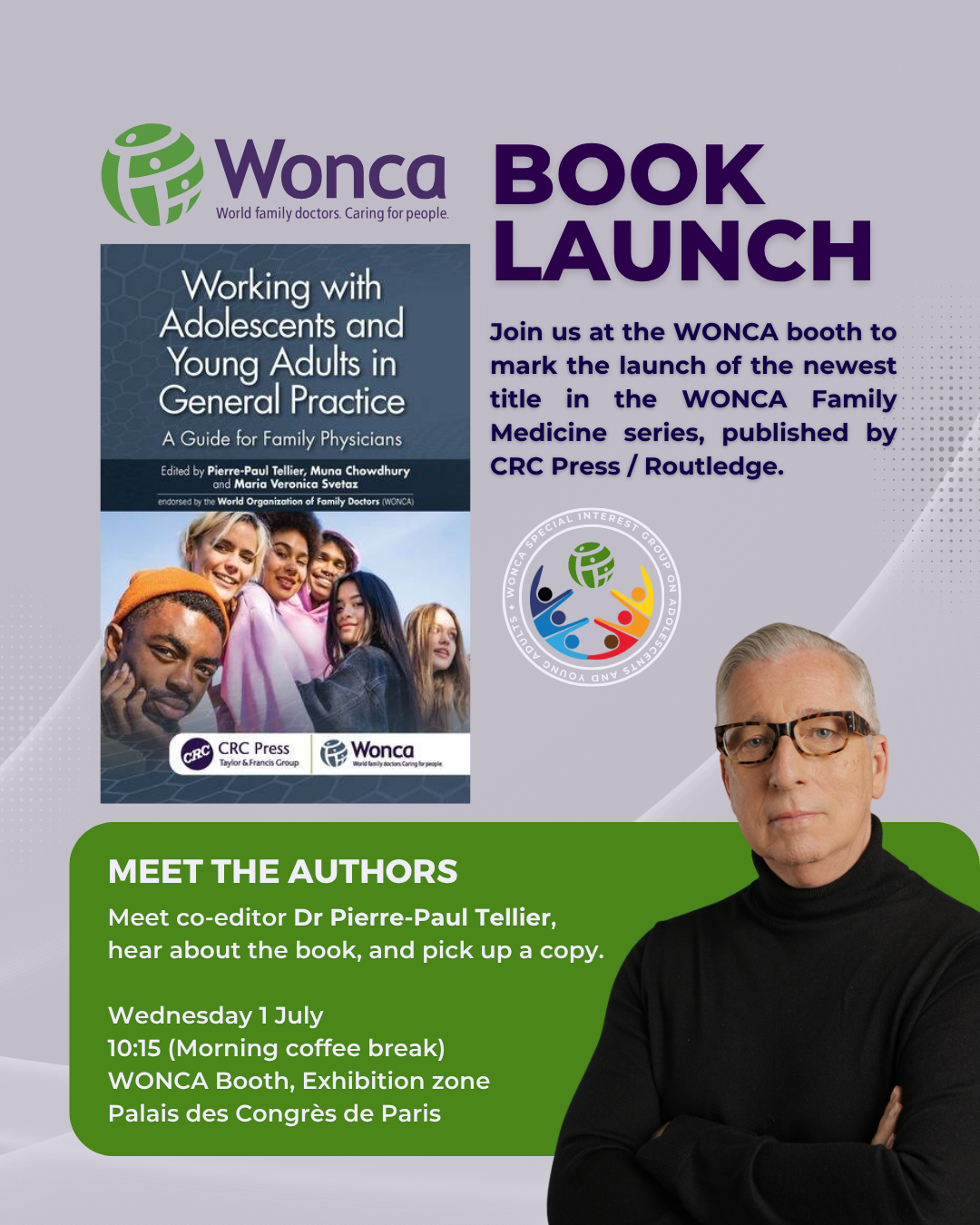
Working with Adolescents and Young Adults in General Practice: A Guide for Family Physicians
Edited by Pierre-Paul Tellier, Muna Chowdhury and Maria Veronica Svetaz
Join us at the WONCA booth to meet co-editor Dr Pierre-Paul Tellier and learn more about the book.
Book launch: Wednesday 1 July, 10:15 – 10:45 (morning coffee break)
Location: WONCA booth, Exhibition zone
The book will be available for purchase at the conference, and can also be ordered here:
Order the book
Explore other titles in the WONCA Family Medicine Book Series:
See the full series